


Cuban Youth Project Uses Journalism as a Tool for Social Change
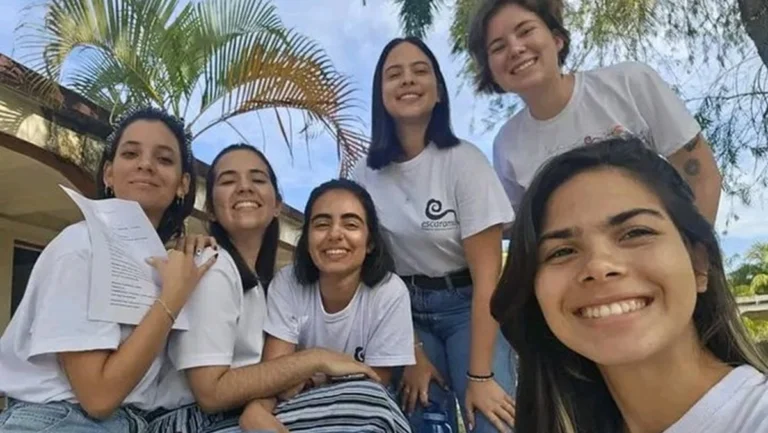
Some young Cubans participating in the Escaramujo project. X/ @ICuba15
September 29, 2025 Hour: 10:07 am
The Escaramujo Project trains teenagers to tell their own stories through documentaries and magazines.
Through its series The Cuban Way (“A lo Cubano”), teleSUR continues to showcase to the world innovative projects that reflect contemporary Cuban society. Its most recent episode focused on the Escaramujo, a project that reimagines journalism as a tool for social change.
RELATED:
2.2 Million in Peril: Cuba’s Explosive ONU Speech Exposes Gaza Genocide and U.S. Blockade
The project’s name comes from a song by Silvio Rodriguez and symbolizes the initiative’s belief in collective commitment and the accessibility of knowledge for social progress.
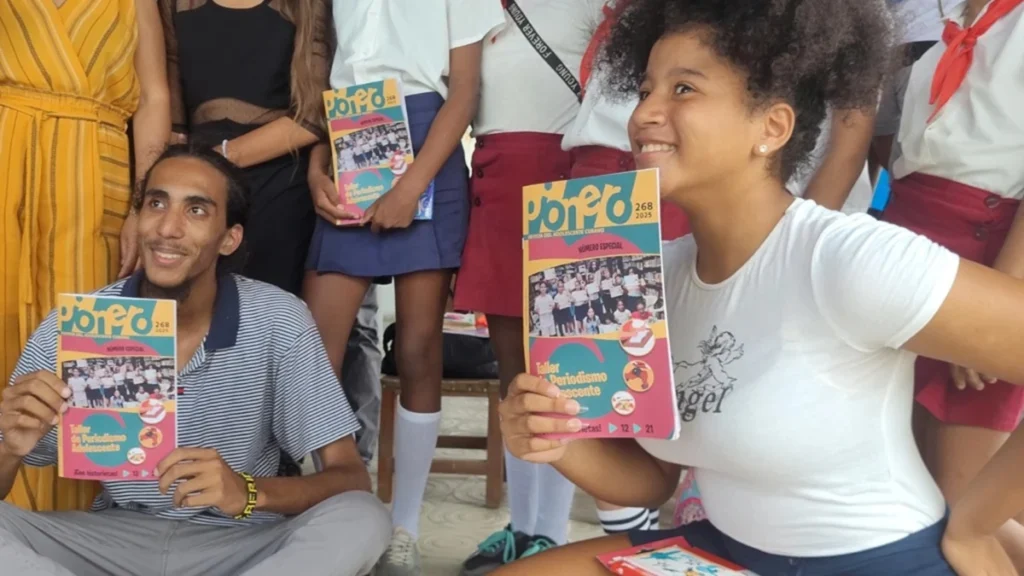
TeleSUR cameras visited a community cultural center in the El Cotorro neighborhood of Havana to document the launch of the latest edition of “Pionero,” a youth magazine produced entirely by teenagers thanks to the Escaramujo.
The project began taking shape in 2010, when Rodolfo Romero Reyes, then a journalism student at the University of Havana, had to visit several educational institutions for a school assignment. He became involved with the Comprehensive Training Schools (EFIS), which enroll teenagers who have committed acts classified as crimes under the law.
“When I encountered that reality, my first instinct was to make a documentary about those teenagers. But then my professors at the time suggested I find a way for them to tell their own stories,” said Rodolfo, who now leads the project.
That idea led him into the world of popular education, until the first workshop became reality: a group of six teenagers would learn to use audiovisual tools to create a product with an impact on their daily lives. It was the first of many workshops to come in the following years.
“They suggested making a documentary about their life stories. And it was very interesting how they told why they had ended up in those schools, what families they came from, the characteristics of their neighborhoods. And while they were telling it, they reflected on it. That experience was very enriching for them, and for us.”
From that first workshop came the idea of replicating the experience in other schools across the country. One of Escaramujo’s central principles was born: thinking of communication as a tool for social transformation.
“We took the name from Silvio Rodriguez’s song, because three of its lines define us: the certainty that knowledge cannot be a luxury, that we live to ask questions, and that we are of the rose and the sea.”
Over the past 15 years, Escaramujo has grown and expanded across the island. Its workshops have produced audiovisuals, documentaries, TV series, and magazines. The project’s coordinators are mostly young university students trained in the principles of popular education.
Luis Ernesto Christy, 20, is a second-year journalism student. He coordinated the workshop that produced the latest edition of Pionero and said the experience has enriched his vision of the profession.
“Getting to know their stories, the way they understand what happens around them, made me realize that journalism is not vertical but should be horizontal. We must make sure they have a voice to tell their experiences. That way, we gain new perspectives and new ways of seeing and making the world,” he said.
One of Escaramujo’s pillars is rooted in a Jose Marti’s principle: teaching young people the importance of being useful to their country and their community.
“Escaramujo is committed to working toward the future, toward building the nation. I have the chance to dedicate time to what I love. But I also understand that the profession is not just reporting daily events; we must contribute to the training of those who come after us. We’ve been fortunate that the young people who join the project bring great sensitivity, good professional preparation and a strong desire to do,” Rodolfo said.
“And they have a commitment to Cuba that is very important. In these times of crisis—an economic crisis, but also a crisis of values—when some young people envision their future outside the country, having youth committed to contributing to making the nation better is very valuable,” he added.
In El Cotorro, enthusiasm fills the laughter of young people reading their magazine together for the first time. “It’s a huge pleasure to see my comic strip in one of the most famous magazines in the country,” said Janice with a big smile. “I feel proud of myself and my achievements,” added Veronica, an eighth-grade student.
Among the teenagers, there is consensus: no one is better suited than they are to address the issues that affect them most.
“These projects really help teenagers express how they feel, to find their place. That way they understand they do have a place in the world and they do need to be heard,” said Melanie, another seventh-grade student who helped create the magazine.
Workshop by workshop, Escaramujo brings together different generations of young people to practice communication from a community-centered perspective, committed to the future of their homeland.
“I’m doing what I can and what I must, from the trench where I belong. Che Guevara said revolutionaries must be where the revolution needs them, and I believe the place where I can give my best effort is where I am right now. That’s what I’m doing, and I’m not holding back,” Luis Ernesto said.
teleSUR/ JF
Source: teleSUR